

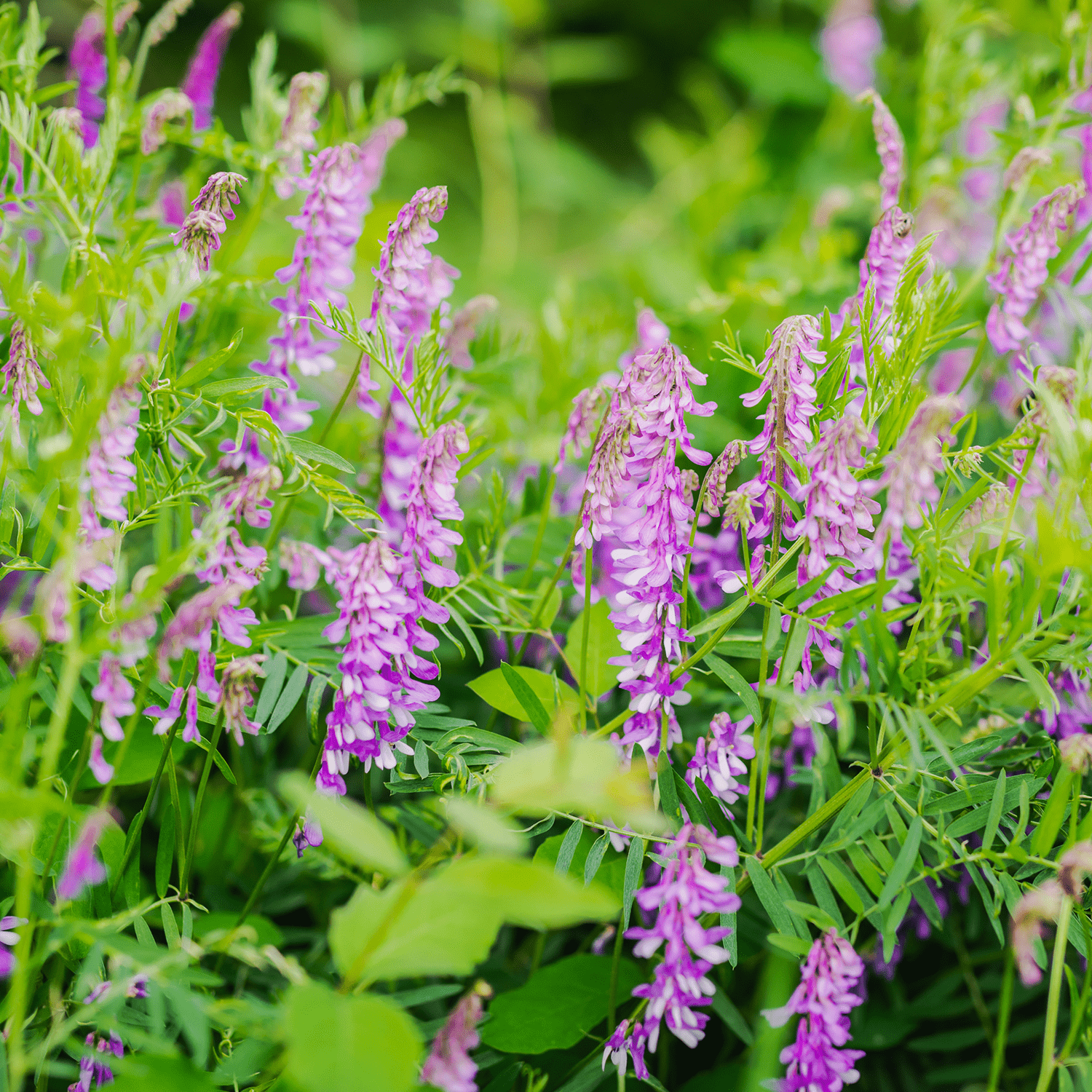
Hairy Vetch (and other legumes) have a huge impact when planted ahead of corn. The bottom line is that these cover crops increase yield. This article will provide some detail on why that is. If you'd like additional info after reading, please contact your local Tidewater Seed rep to discuss your options.
Advantages of Hairy Vetch & Other Legumes
There are three main advantages offered by Hairy Vetch and other legumes when used as a cover crop ahead of corn:
- Nitrogen fixation and improved efficiency
- Increased phosphorus and potassium availability
- Increased water infiltration and water holding capacity
While all legumes offer these advantages, Hairy Vetch has proved itself to be the best option for the Mid-Atlantic. Let's explore why that is...
Nitrogen Production
Hairy Vetch is the top N-fixing legume in the Mid-Atlantic. 2023 legume samples indicated the following results:
- Average of 229 lbs/acre
- Minimum of 59 lbs/acre (late planting and early termination)
- Maximum 484 lbs/acre (early planting and late termination)
- Hairy Vetch performed best, followed by Balansa Clover, Winter Peas, and Crimson Clover
Hairy Vetch offers excellent Nitrogen efficiency. It creates a "slow release" form of Nitrogen. It also stimulates soil microbial populations that improve N-cycling from other sources. Finally, the Nitrogen supply released from Hairy Vetch "flexes" to conditions.
- N-release is a biological process driven by moisture and temperature
- Good moisture (not too much and not too little) with moderate-to-high temperatures increases the decomposition and mineralization of Nitrogen
- Those same conditions increase corn Nitrogen demand
- Conversely, Nitrogen is preserved during conditions not favoring Nitrogen demand
Phosphorus & Potassium Availability
Legume cover crops, including Hairy Vetch, increase P and K availability in two primary ways:
- Pulling P and K from deep in the soil profile to the surface
- Increasing available P and K in the root zone from non-available sources
- Only about 10% of total K in the soil is available
- <5% of total P in the soil is available
2023 legume samples produced the following results:
- Average: 54 lbs P2O5/ac (equivalent to 103 lbs MAP/ac)
- Minimum: 9 lbs P2O5/ac (equivalent to 17 lbs MAP/ac)
- Maximum: 121 lbs P2O5/ac (equivalent to 232 lbs MAP/ac)
- Average: 219 lbs K2O/ac (equivalent to 365 lbs Potash/ac)
- Minimum: 54 lbs K2O/ac (equivalent to 90 lbs Potash/ac)
- Maximum: 461 lbs K2O/ac (equivalent to 768 lbs Potash/ac)
Improving Soil Water
Water is the most limiting yield factor for corn. Just one inch of transpiration results in a loss of about 20 bushels per acre. Cover crops like Hairy Vetch increase soil water supply by:
- Increasing water infiltration
- Decreasing evaporative losses
- Increasing soil water holding capacity
- Increasing effective rooting depth
The impact on corn yield is significant. Corn planted into Hairy Vetch averaged 19 bushels per acre better than corn planted fallow or into an early-killed cover.
How to Plant Hairy Vetch Ahead of Corn
If you're intrigued by the potential offered by Hairy Vetch or other legumes, please contact your local Tidewater Seed rep to discuss further. We can make recommendations about the specific varietal selection and planting process based on your farm's conditions.